Everard disasters
FT Everard & Co
Aqueity, almost scuppered the Cutty Sark which was secured close to the Training Ship Worcester at Greenhithe. This ship was fitted with a 4cylinder 2SA British Polar main engine and not a Newbury Sirron. However the Aqueity name runs through three ships and as it is a jolly yarn, it's worth including,
At 6 p.m. on 30th January 1952, all hands on the Worcester rushed on to the upper deck on feeling a crash on the starboard bow. There, in the darkness, could be seen a fully laden tanker of some 800 tons, belonging to Messrs. F. T. Everard and Sons. Greenhithe, that had run foul of the bow of the Cutty Sark, and powerless to manoeuvre, was interlocked with the clipper and crashing her down in the strong ebb tide alongside the Worcester. The 40 foot jib boom of the Cutty Sark immediately caught the fo'c'sle rails and carried them away, the jib boom itself snapping at the inboard end, carrying away all fittings, including the arm of the " Naughty Witch," the figurehead. The bow of the Cutty Sark then scraped down the Worcester's starboard side, damaging plates, platform and fittings, and carrying away her own stout port cat-davit. Fortunately, the Cutty Sark’s yards were braced round and did not foul those of the Worcester which might have led to serious consequences. Cutty Sark and Aqueity finally drifted astern clear of the Worcester; the latter dropped her anchor, which eventually brought her up, whilst one of the four moorings of the Cutty Sark still held, and with the help of this plus two launches and a tug, Aqueity was held and then slowly towed up river alongside Everard's floating crane. The remaining mooring cable of Cutty Sark was cut in order to free her, and at 2 a.m. Cutty Sark was towed and secured to the Rainham Tier buoys off Erith, where she remained for some days until taken in hand for repair by Messrs. Green and Silley Weir, Ltd., at Shadwell Basin. The missing arm of the "Naughty Witch" was recovered days later at Ward's Wharf, Thurrock, and sent to London for replacing on the damaged figurehead.
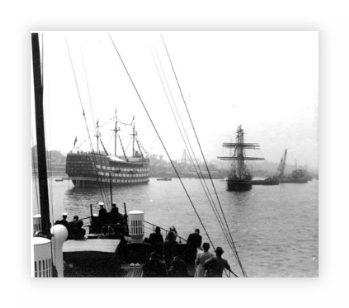
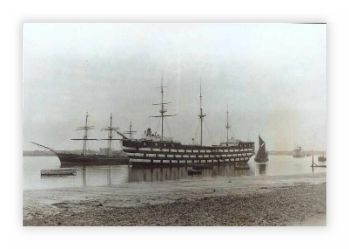
Cutty Sark’s name comes from the famous poem Tam O’Shanter by Robert Burns. It is about a farmer called Tam who is chased by a scantily-clad witch called Nannie, dressed only in a ‘cutty sark’. A cutty sark being a 'short nightdress'. According to legend – although in Robert Burns’ poem – witches are unable to cross water so why a ocean going clipper used a scantily clad witch as it's figurehead is a little surprising.
The original owner of Cutty Sark, a man called Jock Willis, was the person who gave the ship its name, although it was allegedly suggested to him by the ship’s designer Hercules Linton.
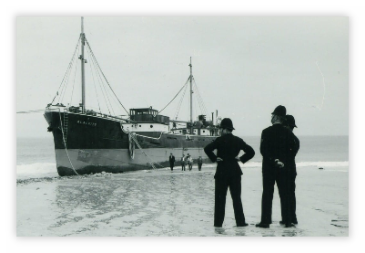
You can't park there sir.!!
Alacrity went aground in thick fog at Portheras Cove, near Pendeen Lighthouse on 13th February (unlucky day!) 1963. She was bound from Swansea to Brussels with anthracite. She was abandoned as a total loss a week or so later and eventually dismantled in situ. At very low tides there are still bottom plates visible. Courtesy (Geoff Hoather, Thames Ship Society TSS Editor and FB Admin.)
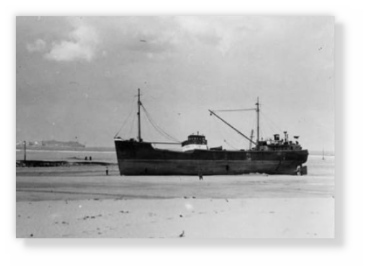
Left
MV Serenity aground at Hayle.
Right
Aqueity Also at rest.
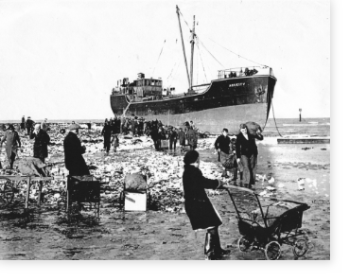
Aqueity ll was a coastal tanker built in 1945 for the Ministry of War Transport as Empire Belgrave and after the war in 1947, sold to FT Everard and renamed. It was lost that same year when it hit a wartime mine off the Dutch coast.
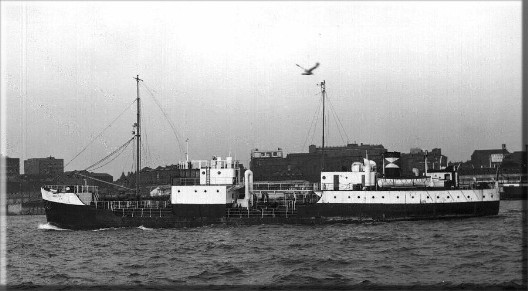
Empire Tedmuir was a 950 GRT coastal tanker built by A & J Inglis Ltd, Glasgow. Launched on 5 February 1946 and completed in May 1946. Sold in 1947 to Anglo-Saxon Petroleum Co Ltd and renamed Fusinus.
Sold in 1949 to F T Everard & Sons Ltd and renamed AqueityIII.
Scrapped in January 1965 at Bruges, Belgium.
MV Fred Everard
11 September 1926 launched by Fellows & Co Ltd, Great Yarmouth as Yard Nr 316 named FRED EVERARD as a steel spiritsail sailing barge for F. T. Everard & Sons Ltd, London. Completed October 1926.
This is the timeline of that ship.
27 December 1927 dragged her anchor off Whitstable in a gale with a cargo of 285 tons of coal. Went ashore at Tankerton. The Master and the crew were saved
December 1938 cut down and converted into a motor coaster and fitted with an oil engine.
The war history is very interesting in that it was used by the Royal Navy as a tender to battleships at Scapa Flo.
My father would have seen this worthy little craft as he served on HMS Hood but was drafted off just before she sailed to her doom.
He later on post war,was employed at the Newbury Diesel Company working in the engine test area.
1941 requisitioned by the Admiralty as a Stores Carrier
26 March 1941 at Scapa Flow alongside HMS HOOD
10 November 1942 at Scapa Flow alongside HMS KING GEORVE V delivering Naval Stores
24 September 1944 at Scapa Flow alongside HMS INDEFATIGABLE delivering torpedoes
1944 Returned to her owners
9 May 1956 while on passage from Rochester, Kent to Totnes, Devon with a cargo of cement was in collision with m.v. Wall Brook and sank in the Princes Channel 8 miles off Margate. Deck Hand Ian Godfrey Hannay discharged dead - drowned.
Data from the Historicl RFA (Rotal Fleet Auxiliry) Website
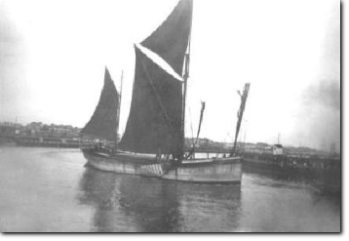
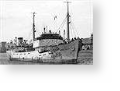
The later MV Fred Everard Launched 1958
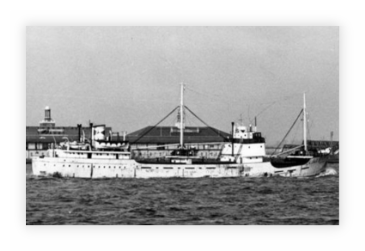
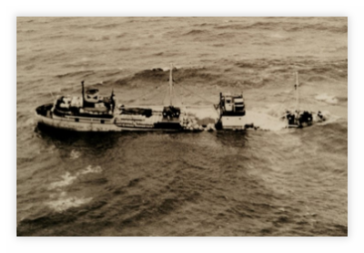
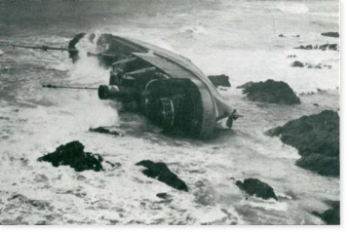
This later MV Fred Everard, went ashore in a snow storm in 1965 under 600 feet high cliffs at Ravenscar, between Scarborough and Whitby. The Whitby lifeboat was launched and took off her crew consisting of the Master, mate and twelve men. The FRED EVERARD had run into gales in the North Sea, causing her deck cargo of paper pulp to get very wet and causing her to take on a severe list. One of the crew reported that the list gradually developed to 30 degrees, by which time some of the cargo was being dumped in an attempt to reduce the angle. On Sunday the 26th November it was reported that her main deck was awash fore and aft at high tide, the vessel upright and apparently on the bottom, but a Salvage Association Officer was unable to board due to bad weather. All that day heavy seas broke over the vessel and she pounded the rocks, her deck cargo washed overboard, listing 50-60 degrees starboard with all her boats gone, and it was feared she would become a total loss. By the 1st December she was commencing to break up, and the following day when almost completely submerged, lying on her side at Blewick Point, Ravenscar, in a very exposed position and inaccessible, she was declared a total loss.
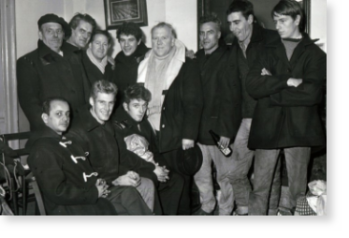
The crew rescued by the Whitby Lifeboat are pictured above. The person in the centre of the back row was one of the lifeboatmen.
The F.T. Everard & Sons-owned ship Allegrity carrying 700 tonnes of lubricating oil was on its way from Le Havre in France to Stanlow Oil Refinery at Ellesmere Port when it struck Greeb Point on the Roseland Peninsula on December 13, 1961. The ship finally ran aground at Porthluney Cove, close to Mevagissey.
All 14 crew members rescued with the skipper and one engine man being the last to leave and reach the safely of the lifeboat, it headed back to Falmouth. A tug reached the station at 11.30am. but eventually, Allegrity capsized and was deemed a total loss.